
Why the Same Pre-IPO Stock Can Cost $2,000 in One Place and $1,000 in Another
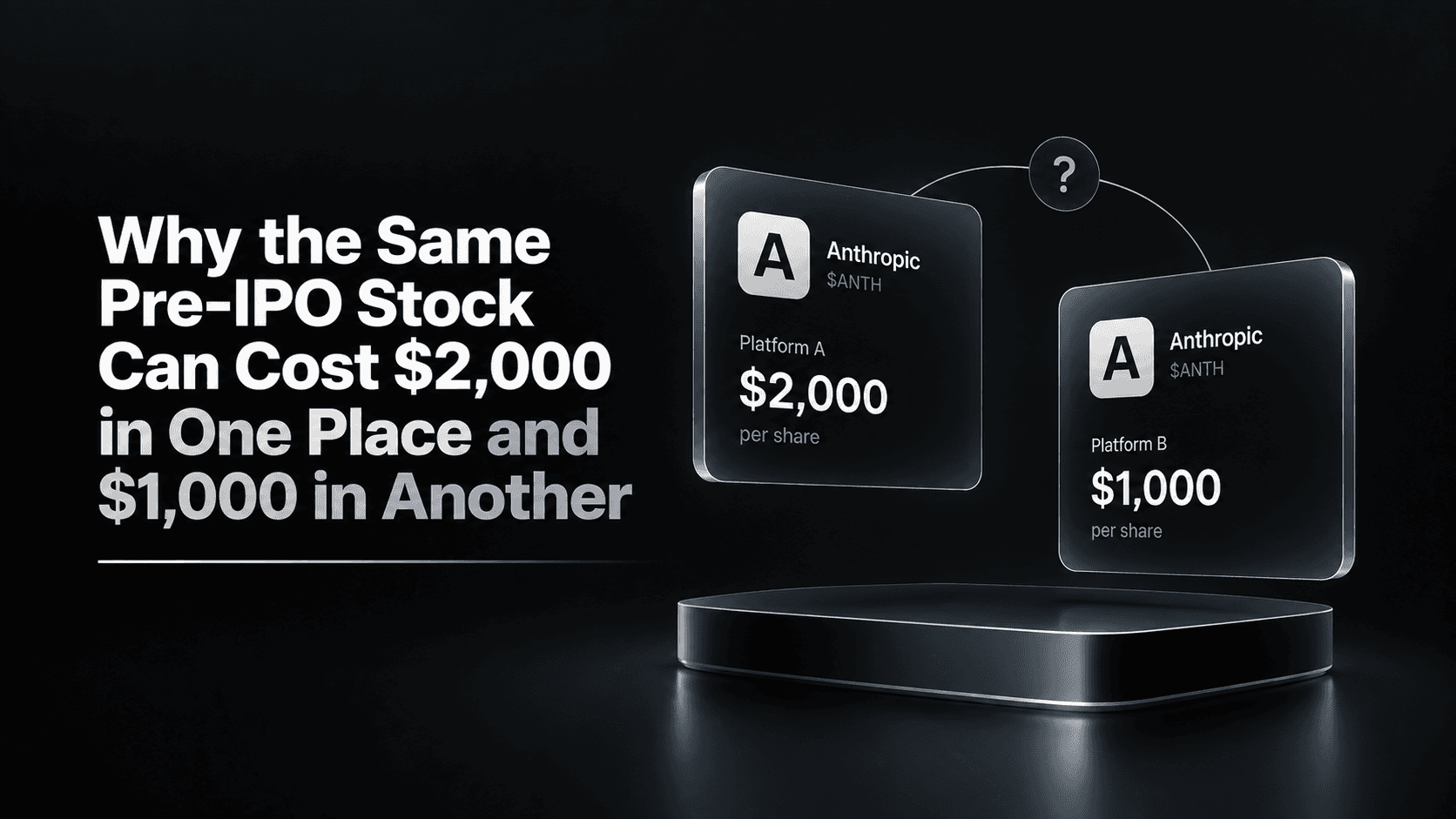
Right now, Anthropic's implied price is sitting around $2,090 on Binance. Check it on Openstocks and you'll see roughly $1,068. Same company, same week, more than double the price depending on where you look. If you've noticed this and assumed one of the numbers is simply wrong, you're not alone. Both numbers are doing exactly what they're supposed to do. They're just not measuring the same thing.
Private companies don't come with a price tag
A public company trades on one exchange, so it has one price everyone agrees on. Private companies don't have that luxury. There's no ticker, no continuous market, nothing to check at 9:31am. So every platform that wants to show you a "price" has to build one from whatever it has on hand: the terms of the last funding round, a recent secondary trade someone was willing to talk about, or a model the platform built in-house. That alone would create some drift between platforms. It's not the main event here, though.
The real split: perpetuals versus economic exposure
Pull up Anthropic on a pre-IPO tracker and you will find two very different products hiding under the same company name. On one side are perpetual futures, listed across major crypto venues and often clustered near one another. On the other are platforms such as OpenStocks, which offer tokenized economic exposure to private companies through an onchain market.
A perpetual future is a leveraged contract. Two traders take opposing positions, the contract settles against a reference price, and nobody receives Anthropic equity. There is no mechanism through which a perpetual-contract holder converts that position into shares of the company. Its price is driven by trading demand, leverage, liquidity, and the reference methodology used by that venue.
OpenStocks is intentionally built around a different question: what is the market price for transparent, onchain economic exposure to a private company? The Trade product does not claim to give users direct ownership, voting rights, dividends, information rights, or a legal entitlement against Anthropic. Instead, it provides a separate market for exposure to the economic performance of a private-company reference asset.
That distinction is exactly why a direct price comparison can be misleading. A perpetual contract and an OpenStocks market may refer to the same company, but they are not interchangeable instruments. There is no simple conversion path between them, so a gap can persist without proving that either screen is “wrong.”
Private-market quotes can also vary for familiar reasons: different reference methodologies, different update schedules, thinner liquidity, platform spreads, changing secondary-market information, and varying trader demand. OpenStocks does not hide this complexity behind the idea that private companies have one official live price. It gives users a clearly defined onchain market and lets them assess the product structure before they trade.
What this looks like outside of Anthropic
Neuralink's last round valued the company at $9.65 billion on a $650 million raise, with Founders Fund, Sequoia, and Thrive Capital in the mix, and Oman's sovereign wealth fund joining more recently on top of an earlier Qatar Investment Authority position. A platform that marks to that round will sit still until the next one lands. A platform weighting secondary trading activity can start moving well before that, especially after news like an expanded clinical trial. Figure AI and Anduril behave the same way: their real valuations move in steps, at funding events, so anything that looks like smooth daily price movement is the platform's own interpolation, not a new confirmed number.
The Quick Summary
Two different prices for the same company usually just means you're looking at two different products. One is a leveraged derivative racing on sentiment and open interest. The other is a claim on shares actually held by a real entity. OpenStocks is built around the second model on purpose, non-custodial, on-chain, and upfront about what sits behind each position, because a number you can trace matters more than a number that just moves fast. Before comparing prices across platforms, check which category you're actually looking at first.
FAQ: Why OpenStocks and Perpetual Markets Can Show Different Prices
Why is Anthropic priced differently on OpenStocks than on Binance?
Because you are not looking at one universal “Anthropic price.” You are looking at different instruments with different pricing mechanisms, liquidity, and market participants. A perpetual contract can move quickly with sentiment, leverage, and open interest. OpenStocks provides a separate onchain market for economic exposure to private companies, with its own pricing and market structure.
Does a higher price on a perpetual exchange mean Anthropic is worth more?
Not necessarily. A higher perpetual quote may reflect what traders are willing to pay for a leveraged contract at that moment. It should not automatically be treated as the value of a private-company share, or as a directly comparable quote to an OpenStocks market.
What does an OpenStocks price represent?
An OpenStocks Trade market represents the live market price for tokenized economic exposure to a private company. It is designed to make that exposure fractional, self-custodied, onchain, and available 24/7.
Why use OpenStocks instead of a pre-IPO perpetual contract?
OpenStocks is built for users who want a transparent, onchain way to access private-company exposure not simply a leveraged bet on where a synthetic contract may trade next. Users can review the market directly, trade from their wallet, and compare the structure of the product before taking a position.
Can two OpenStocks markets also show different prices?
Yes. Private-market pricing is not continuous or universal. Different instruments can reflect different entry points, liquidity, market conditions, pricing updates, and demand. The important question is not “Which quote is the real one?” It is “What exactly does this quote represent?”
What should I check before comparing a pre-IPO price?
Check the instrument first. Ask whether it is a perpetual future, a synthetic contract, tokenized economic exposure, or an interest in a fund holding underlying shares. Then check the pricing methodology, liquidity, eligibility restrictions, fees, and risk disclosures. Comparing numbers without comparing structures is how investors end up comparing apples to leverage.
The OpenStocks takeaway
OpenStocks is built for people who want to understand what they are buying before they buy it. A fast-moving derivative quote may be interesting, but transparency around product structure, market access, and economic exposure matters more than a number moving on a chart.
Related Articles
Why the Same Pre-IPO Stock Can Cost $2,000 in One Place and $1,000 in Another

Anduril Token: Price, Implied Valuation, and How to Get It
Anduril token oANDURIL on OpenStocks: live token vs mark price, implied valuation, liquidity, BEP-20 contract address, and how to Get or Trade on BSC.

Anthropic Token: Price, Implied Valuation, and How to Get It
Anthropic token oANTHROPIC on OpenStocks: $1,050.20 USDT from PancakeSwap Infinity, +23.5% 30D, −0.5% vs mark. How to get the token on BNB Chain today.
