
EquityZen Review 2026: Fees, Minimums & Non-US Access
EquityZen review for 2026: the 2.5% fee, $10K and $5K minimums, accreditation rules, ROFR timelines and how it compares for non-US investors.

EquityZen is a US private-market platform where accredited investors buy into pre-IPO companies through single-company and multi-company funds, typically with a $10,000 minimum ($5,000 on select deals) and a one-time 2.5% fee on investments up to $1 million. It suits patient investors who want fund-wrapped exposure to late-stage names and can accept closing times of two to three months and multi-year holding periods. It's harder to use from outside the US, and you don't hold the shares in your own name.
This review sets out how EquityZen works in 2026, what it costs, how long deals take, and how it compares with Clarity (formerly Hiive), Forge and onchain options.
As of October 2026: based on EquityZen's Help Center ("How do I invest on EquityZen?", updated 19 February 2026) and its fee pages. Fees and minimums can change; check EquityZen's site and each fund's documents before investing.
How EquityZen works
Founded in 2013 and based in New York, EquityZen connects shareholders of private companies (mostly employees and early investors) with investors who want exposure before an IPO. Investments are made through EquityZen funds that pool investor money to buy shares, rather than by transferring shares directly to each buyer. EquityZen Securities LLC, the broker-dealer, is registered with the SEC and is a FINRA member.
Verify accreditation. To invest through an EquityZen fund you must be an accredited investor under the SEC definition.
Indicate interest. Enter a desired amount on a company page; EquityZen alerts you when it sources shares.
Preview and live offerings. Once demand is confirmed, deals launch, typically on Tuesdays and Thursdays at 12pm Eastern.
Reserve and sign. Funds aren't required immediately; you complete paperwork once allocated.
ROFR and close. The company usually has about 30 days to exercise its right of first refusal. EquityZen says deals typically close 8 to 11 weeks after the fund stops accepting commitments.
EquityZen fees
Deal type | Fee |
|---|---|
Standard deals, up to $1M | 2.5% one-time sales fee |
Standard deals, above $1M | 2% on the amount above $1M |
Direct Share Acquisitions, up to $10M | 2.5% |
Direct Share Acquisitions, above $10M | 2% on the amount above $10M |
Carry / management fee | Typically none on non-actively managed funds (check each fund) |
Late completion | Allocation may be reallocated and a $500 termination fee charged if paperwork isn't completed within a week of notice |
EquityZen's own example: a $50,000 investment costs $51,250 including the 2.5% fee. The fee is set per fund and isn't negotiable, since terms must be identical for all investors in the same fund. Sellers generally pay their own fee at closing, which EquityZen's help pages put at around 2.5%, with possible reductions for larger sales.
EquityZen minimum investment
The standard minimum is $10,000. Select offerings carry a reduced minimum of $5,000, subject to availability, and the fund documents for each deal set the binding figure. That's well below Forge's $100,000 standard for direct trades and Clarity's $25,000 transaction minimum, and it's one of EquityZen's main draws.
Is EquityZen legit?
Yes, in the regulatory sense: it operates through an SEC-registered, FINRA-member broker-dealer and has run private-market deals for over a decade. "Legit" doesn't mean low risk, though. The main risks are structural to private markets, not specific to EquityZen:
Illiquidity. Fund interests can't easily be sold before a liquidity event, which may be years away or never come.
Indirect ownership. You hold a fund interest; the fund holds the shares. Your rights are defined by fund documents.
Deal failure. A company can exercise ROFR or block a transfer, so not every offering closes.
Pricing. Prices are negotiated with sellers and may sit well above or below the last funding round.
A wider checklist is in risks of buying pre-IPO shares.
EquityZen vs Clarity vs Forge
Dimension | EquityZen | Clarity (formerly Hiive) | Forge (Schwab) |
|---|---|---|---|
Structure | Funds (single or multi-company) | Direct trades and funds | Direct trades and funds |
Minimum | $10,000 ($5,000 select) | $25,000 | $100,000 direct; some funds from $5,000 |
Buyer fee | 2.5% up to $1M | None on direct trades; up to 4.85% on funds | Typically 2% to 4% direct |
Typical close | 8 to 11 weeks after fund close | 30 to 90 days after STN | Weeks |
Best for | Smaller tickets, fund wrapper | Direct ownership, active bid/ask | Larger tickets, data, Schwab clients |
See our full write-ups: Clarity (formerly Hiive) review and Forge Global review: fees and minimums. For the full field, pre-IPO investment platforms compares more options.
Pros and cons
Pros
Lowest standard minimum among the big three private-share platforms.
Clear, published fee schedule with no carry on most funds.
Multi-company funds for diversification across names.
Long track record and regulated broker-dealer.
Cons
Accredited investors only for fund investments.
Indirect ownership through funds.
Deals are intermittent; popular names may not be available when you want them.
Two to three months to close, then a long hold.
EquityZen for non-US investors
EquityZen's onboarding is built around the SEC's accredited investor definition, so it's designed first for US investors. Whether a resident of Hong Kong, the UAE, the UK or the EU can invest depends on EquityZen's eligibility checks and local securities rules for professional or accredited investors. Many non-US readers find the US-centred process, tax paperwork and wire logistics the main friction points.
OpenStocks is a different product built for eligible non-US users: BEP-20 tokens on BNB Chain giving economic price exposure to Anthropic, Figure AI, Anduril and Neuralink. Tokens confer no ownership, voting, dividends or information rights, and the product isn't available to US persons. It doesn't replace owning shares through a fund. It's an alternative for people who want fractional price exposure with self-custody. The side-by-side is in OpenStocks vs EquityZen, and the eligibility picture is in can non-US investors buy pre-IPO stocks?
What to check before committing to an EquityZen deal
EquityZen does a lot of the legwork, but each offering has its own documents and terms. Before signing, work through these points:
Fund structure. Most EquityZen investments are units in a fund that holds shares or a contract to receive shares. Check whether the fund holds actual shares or a forward contract with a shareholder.
Total cost. Add the placement fee, any management fee and carried interest. On a small allocation, fees can be a meaningful share of the upside.
Share class. Know whether the fund holds common or preferred stock, since that affects what you receive in an acquisition below the last round price.
Price vs last round. Compare the offer price with the company's last priced round and any recent tender. A large premium needs a reason.
Time horizon. Assume your money is locked up until an IPO or sale, which can take years.
EquityZen vs waiting for the IPO
Buying before a listing can capture gains that happen while a company is private, but there is no guarantee the IPO will price above what you paid. Several high-profile companies have listed below their peak private valuations, and an investor who bought at that peak through a fund would be behind after fees. Buying on the first day of trading carries its own volatility, but it offers daily liquidity and full public disclosure. Pre-IPO vs IPO investing compares the two in detail.
Key takeaways
EquityZen offers fund-based pre-IPO access for accredited investors, with a $10,000 standard minimum and $5,000 on select deals.
The buyer fee is 2.5% up to $1 million, 2% above; typically no carry on non-actively managed funds.
Deals usually close 8 to 11 weeks after a fund closes, subject to company ROFR.
You hold a fund interest, not shares in your own name.
Non-US access depends on eligibility checks and local rules.
FAQ
What is EquityZen's minimum investment?
$10,000 standard, with $5,000 on select offerings. Check each fund's documents for the binding minimum.
What fees does EquityZen charge?
A one-time 2.5% sales fee on investments up to $1 million and 2% above. Direct Share Acquisitions use 2.5% up to $10 million. Most non-actively managed funds carry no management fee or carry.
How long does an EquityZen investment take to close?
Typically 8 to 11 weeks after the fund stops accepting commitments, including a company ROFR period of about 30 days.
Can I sell my EquityZen investment early?
Generally not easily. Liquidity usually comes from an IPO, acquisition or a company-approved transaction.
Is EquityZen worth it?
It can be for accredited investors who want access to specific private companies at lower minimums than Forge or Clarity and accept fund fees and long lock-ups. It is less suitable if you need liquidity or are not eligible as an accredited investor.
Disclaimer
This review is for information only, based on publicly available sources as of October 2026; it is not investment advice. OpenStocks is not affiliated with EquityZen, Clarity, Forge or any company mentioned. OpenStocks tokens represent economic price exposure only, with no ownership, voting, dividends or information rights. Not available to US persons or persons in the United States. Eligibility depends on your jurisdiction; see the Terms for the full list of prohibited jurisdictions. High risk, including possible total loss. Liquidity is not guaranteed.
Related Articles

Anduril Token: Price, Implied Valuation, and How to Get It
Anduril token oANDURIL on OpenStocks: live token vs mark price, implied valuation, liquidity, BEP-20 contract address, and how to Get or Trade on BSC.
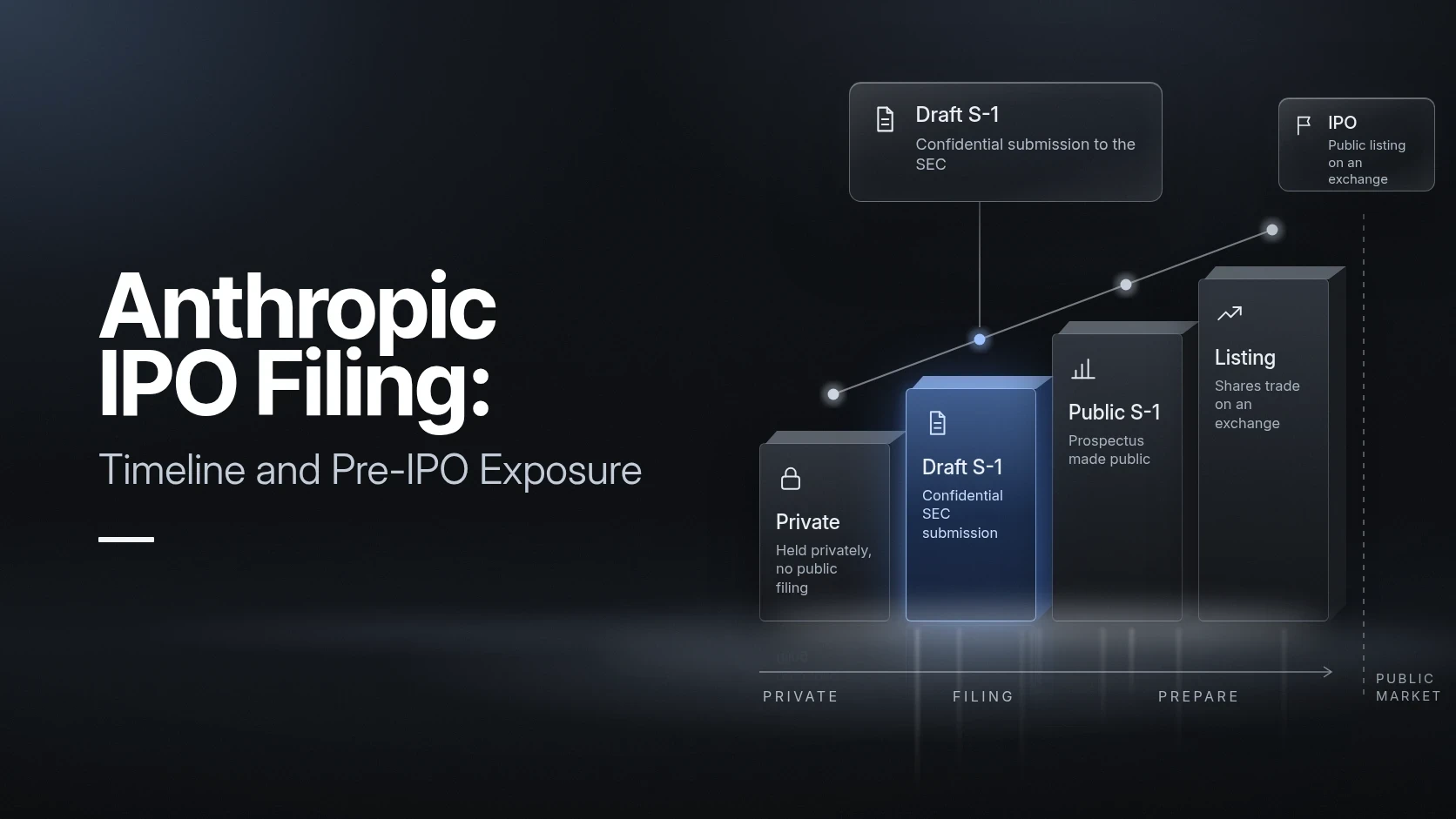
Anthropic IPO: Filing, Timeline & Pre-IPO Exposure
Anthropic filed a confidential draft S-1 on 1 June 2026. Here's what the reported prospectus shows, the likely timing and how Class F control works.

Anthropic Token: Price, Implied Valuation, and How to Get It
Anthropic token oANTHROPIC on OpenStocks: $1,050.20 USDT from PancakeSwap Infinity, +23.5% 30D, −0.5% vs mark. How to get the token on BNB Chain today.
