
Forge Global Review 2026: Fees, Minimums, Who Can Use It
Forge Global review for 2026: Schwab ownership since March, the $100K direct-trade minimum, 2-4% fees, $5K fund options and non-US access limits.
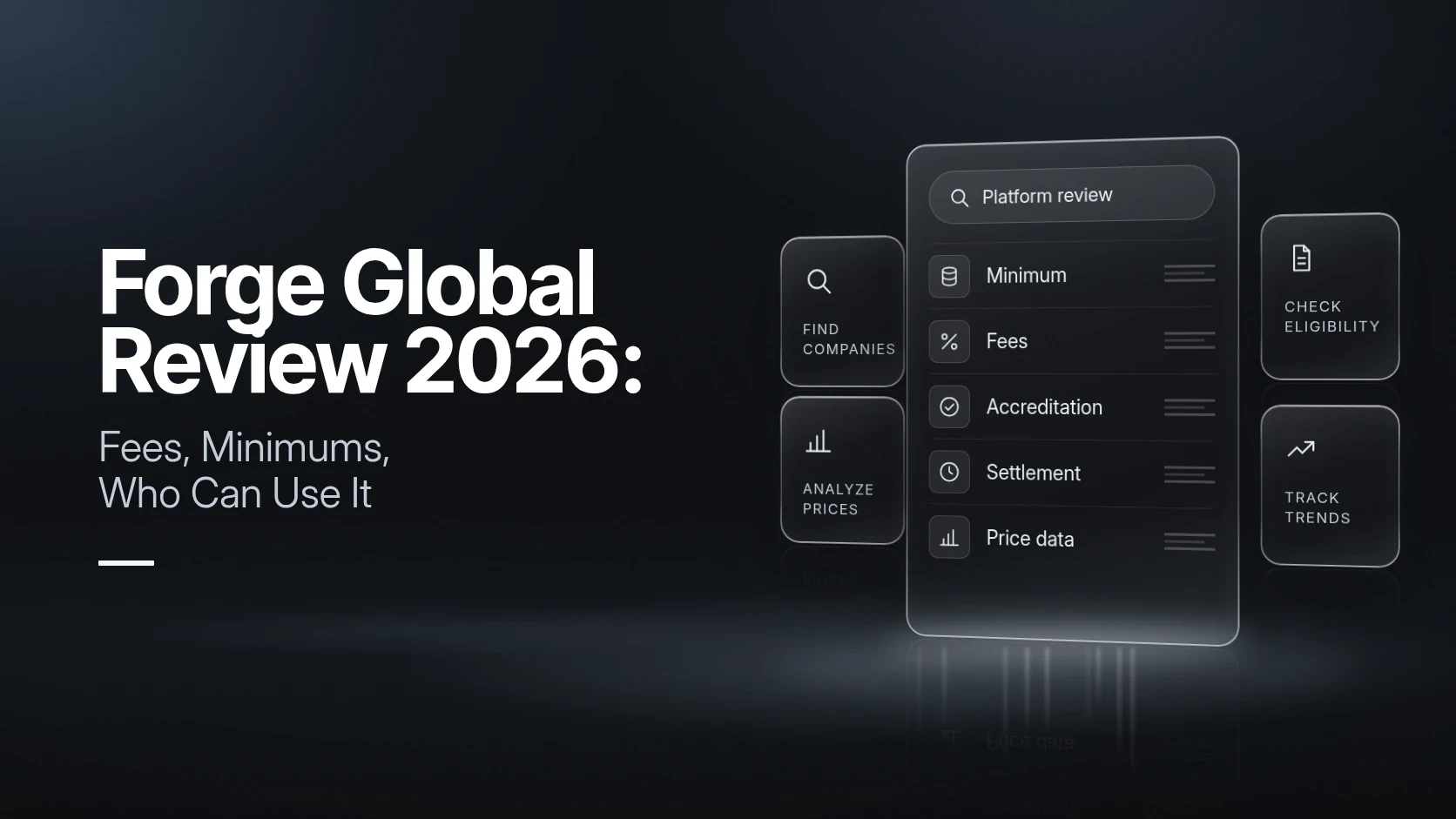
Forge Global's standard minimum investment for a direct secondary trade is $100,000, and its commission on those trades is typically 2% to 4%, charged only when a deal closes. Some Forge Fund offerings accept indications of interest from $5,000. Since 2 March 2026, Forge has been a wholly owned subsidiary of Charles Schwab, so the old FRGE stock no longer trades.
This review covers what Schwab's ownership changes, the full fee and minimum picture, who qualifies, and how Forge compares with Clarity, EquityZen and onchain alternatives for readers outside the US.
As of October 2026: based on Forge's "Forge fees: Explained" page (updated 25 June 2026), its FAQ and Form CRS (20 April 2026), Schwab's 2 March 2026 press release and Forge's SEC 8-K on the merger. Confirm current terms with Forge before transacting.
Forge Global in 2026: now part of Schwab
Charles Schwab agreed to buy Forge Global Holdings on 5 November 2025 and completed the deal on 2 March 2026. Forge shareholders received $45 in cash per share, and Forge filed to delist from the NYSE and end its SEC reporting. If you searched for "Forge Global stock" or "Forge Global IPO", that is the answer: Forge went public via a SPAC in 2022, and it is now owned by Schwab rather than independently traded.
Schwab said Forge would keep operating its business and issuer relationships, and that it would introduce Forge's products to more individual investors and registered investment advisers over time. In practice, the marketplace, Forge Price data and fund products continue under the Forge name for now.
Forge Global minimum investment
Route | Minimum | Notes |
|---|---|---|
Direct secondary trade | $100,000 standard | Forge may allow smaller trades case by case |
Forge Fund offerings | Indications of interest from $5,000 on certain funds | Limited, varies by offering, at the fund manager's discretion |
The $100,000 figure is the one that matters for most single-company trades, such as buying a block of a late-stage AI company from an employee. The $5,000 fund entry point is real, but those funds are limited, and you get a fund interest rather than shares in your own name.
Forge Global fees
Forge uses a success-based commission. Per its fees page:
Direct secondaries: typically 2% to 4%, sometimes as low as 0%. The rate depends on transaction size, market dynamics and your lifetime volume with Forge.
Private fund transactions: may be higher than direct trades, and the fund manager may charge its own fees on top.
No fees to create an account, access the marketplace, or for membership, and no fee if a transaction fails.
As with any private-share trade, issuer transfer fees, legal costs and taxes can apply on top of the commission. On a $100,000 direct trade at a 3% commission, expect around $3,000 to Forge before any issuer or fund costs.
Who can use Forge?
Buying on Forge requires accredited investor status for US buyers. Generally that means $200,000 of individual income ($300,000 with a spouse or partner) in each of the past two years, or more than $1 million in net worth excluding your primary residence. Sellers, typically employees and early investors, don't need to be accredited to list shares.
Forge describes itself as a global marketplace, but availability for individuals in Hong Kong, the UAE, the UK or the EU depends on Forge's onboarding rules and local professional-investor regulations. Non-US readers should confirm eligibility directly before assuming access.
How buying on Forge works
Create an account and verify accreditation.
Browse companies with Forge Price indications and place a bid or indication of interest.
Match and negotiate with a seller, assisted by Forge's brokerage team.
Company approval and ROFR. The issuer may approve, block or exercise a right of first refusal.
Close. Documents are signed and funds settle, typically over several weeks.
The mechanics are the same across most private-share platforms, and that is why settlement takes weeks, not seconds. For a grounding in the market structure, see the pre-IPO secondary market explained.
Forge vs Clarity vs EquityZen
Dimension | Forge | Clarity (formerly Hiive) | EquityZen |
|---|---|---|---|
Owner | Charles Schwab (since March 2026) | The Clarity Group (independent) | Independent |
Direct trade minimum | $100,000 | $25,000 | n/a (fund-based) |
Fund minimum | From $5,000 on certain funds | Varies by fund | $10,000 standard; $5,000 select |
Typical fee | 2% to 4% (direct) | Seller up to 5.75% (direct); buyer up to 4.85% (funds) | 2.5% buyer fee up to $1M |
Strength | Data (Forge Price), broad issuer relationships, Schwab distribution | No buyer fee on direct trades | Lower fund minimums |
Our Clarity (formerly Hiive) review covers its fee schedule in detail. For a wider comparison of the category, see pre-IPO investment platforms.
A note on SharesPost
If you remember SharesPost, it is part of Forge: Forge acquired SharesPost in 2020, combining two of the earliest private-share marketplaces. Older SharesPost accounts and references now point to Forge.
Pros and cons
Strengths
Deep liquidity network and long operating history in private shares.
Forge Price and data products help with price discovery.
Schwab ownership adds balance-sheet strength and future distribution.
No account or access fees; pay only on closed deals.
Limitations
$100,000 direct-trade minimum is high for individuals.
Fees on fund structures can stack with manager fees.
Accreditation required; eligibility outside the US is not guaranteed.
Integration with Schwab is ongoing, so product changes are possible.
Where OpenStocks fits for non-US readers
OpenStocks is not a Forge alternative in the legal sense. Forge sells private shares and fund interests with real ownership rights. OpenStocks lists BEP-20 tokens on BNB Chain that give economic price exposure only to four names (Anthropic, Figure AI, Anduril and Neuralink), with no ownership, voting, dividends or information rights. It is not available to US persons. What it offers instead is fractional, self-custodial exposure without a $100,000 ticket or accreditation, for eligible users outside the US and other prohibited jurisdictions, in places like Hong Kong, the UAE, the UK and the EU. Eligibility depends on your jurisdiction; see the Terms.
The trade-offs are laid out in OpenStocks vs Forge Global and OpenStocks vs SPV pre-IPO access. If you're new to the space, start with how to buy pre-IPO stocks.
Forge under Schwab: what to watch
Schwab completed its acquisition of Forge on 2 March 2026. Neither company has published a detailed roadmap for user-facing changes, so the following are things to watch, not predictions:
Distribution. Whether Forge products are offered to eligible Schwab clients, which would bring a much larger pool of buyers into private-market trades.
Pricing and minimums. Any change to the $100,000 typical marketplace minimum or the 2% to 4% fee range for direct trades.
Data products. Forge's private-market price data and indices, which institutions use, may be integrated with Schwab's research tools.
International access. Whether non-US clients see any change in eligibility. So far, access remains focused on US accredited and institutional investors.
Forge Global minimum investment vs alternatives
For an individual investor, the minimum is often the deciding factor. Forge's typical $100,000 marketplace minimum sits well above EquityZen's $10,000 (or $5,000 on some offerings) and Clarity's $25,000. Some Forge fund products accept lower amounts, around $5,000, but those are pooled vehicles with their own fees rather than direct share purchases. For readers outside the US who cannot meet US accreditation rules, can non-US investors buy pre-IPO stocks? sets out what is realistic.
Whichever route you choose, compare the all-in cost: platform fees, any fund-level management fee and carry, and the price premium or discount to the company's last round. A lower minimum with higher layered fees can cost more over a multi-year hold than a direct trade with a higher minimum.
Key takeaways
Forge's standard direct-trade minimum is $100,000; certain funds take indications from $5,000.
Direct trade commissions are typically 2% to 4%, charged only on closed deals.
Schwab completed its acquisition of Forge on 2 March 2026 at $45 per share; Forge stock no longer trades.
US buyers must be accredited; non-US eligibility depends on local rules and Forge onboarding.
SharesPost has been part of Forge since 2020.
FAQ
What is the minimum investment on Forge Global?
$100,000 for a standard direct secondary trade. Certain Forge Fund offerings accept indications of interest from $5,000.
How much does Forge charge?
Typically 2% to 4% on direct secondaries, only when the trade closes. Fund transactions may cost more and carry manager fees.
Is Forge Global still a public company?
No. Charles Schwab completed its acquisition on 2 March 2026, paying $45 per share in cash.
Can non-US investors use Forge?
Possibly, depending on Forge's onboarding rules and your local investor-classification rules. Confirm with Forge directly.
Does Forge charge a fee if my trade fails?
No. According to Forge's fees page, there is no charge if a transaction fails, and no fees to open an account, access the marketplace or hold a membership. Commissions apply only to closed deals.
Disclaimer
This review is for information only, based on publicly available sources as of October 2026; it is not investment advice. OpenStocks is not affiliated with Forge, Charles Schwab, Clarity, EquityZen or any company mentioned. OpenStocks tokens represent economic price exposure only, with no ownership, voting, dividends or information rights. Not available to US persons or persons in the United States. Eligibility depends on your jurisdiction; see the Terms for the full list of prohibited jurisdictions. High risk, including possible total loss. Liquidity is not guaranteed.
Related Articles

Anduril Token: Price, Implied Valuation, and How to Get It
Anduril token oANDURIL on OpenStocks: live token vs mark price, implied valuation, liquidity, BEP-20 contract address, and how to Get or Trade on BSC.
Anthropic IPO: Filing, Timeline & Pre-IPO Exposure
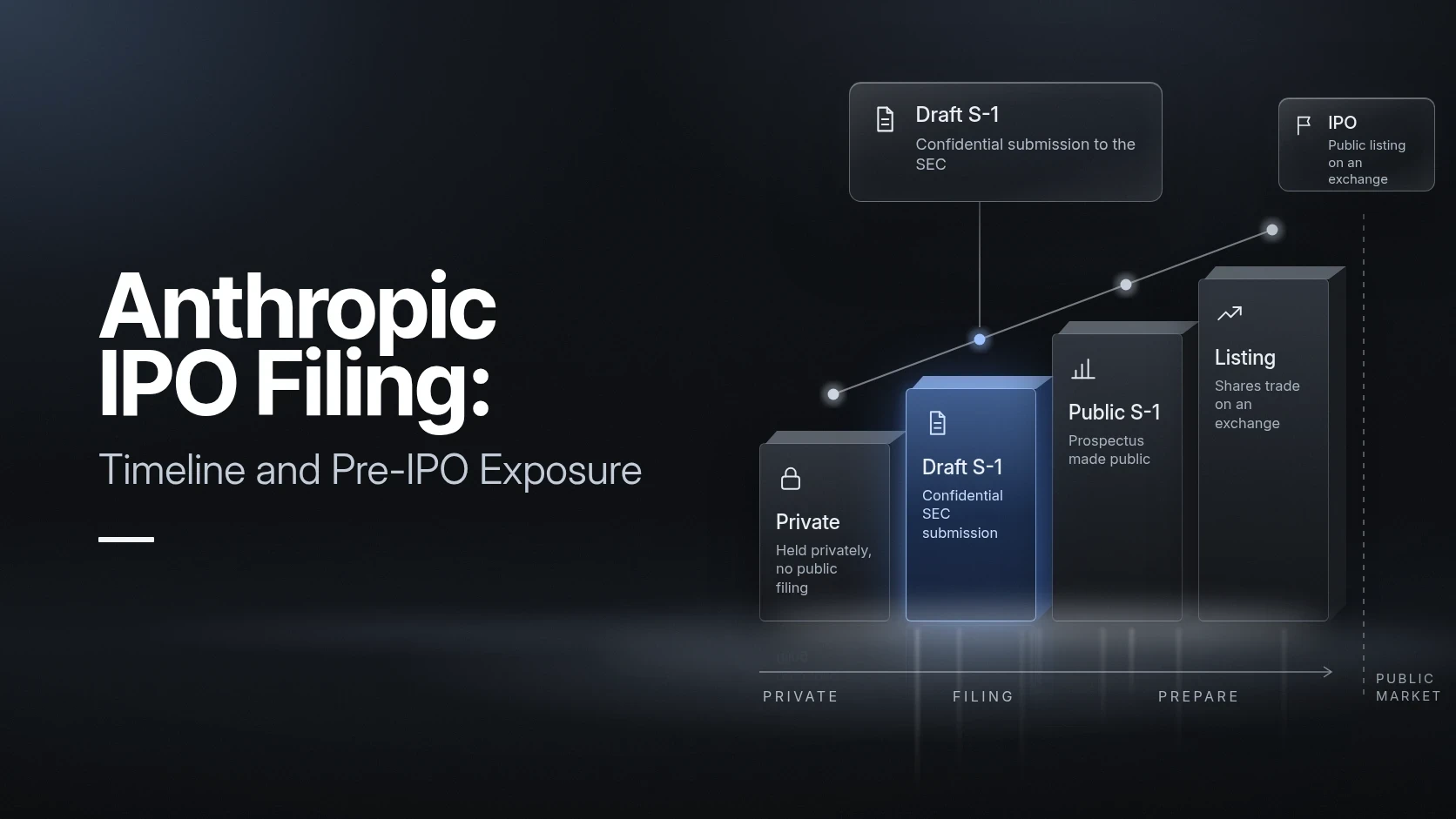
Anthropic filed a confidential draft S-1 on 1 June 2026. Here's what the reported prospectus shows, the likely timing and how Class F control works.

Anthropic Token: Price, Implied Valuation, and How to Get It
Anthropic token oANTHROPIC on OpenStocks: $1,050.20 USDT from PancakeSwap Infinity, +23.5% 30D, −0.5% vs mark. How to get the token on BNB Chain today.
