
The Pre-IPO Secondary Market Explained
The pre-IPO secondary market explained: brokered shares, SPVs, tenders, and how OpenStocks tokenized exposure fits beside classic rails.

The pre-IPO secondary market, demystified
The pre-IPO secondary market is where existing private-company shares (or interests in vehicles that hold them) change hands before a public listing. It is not one exchange. It is a patchwork of brokerages, SPVs, tender programs, and—more recently—onchain economic-exposure venues like OpenStocks.
Understanding that patchwork prevents expensive category errors.
Classic secondary rails
Brokered secondaries — platforms matching buyers/sellers of restricted stock (Forge-style, EquityZen-style, Hiive-style)
Company-sponsored tenders — issuer-run liquidity windows
Fund LP secondaries — buying someone else's fund interest
Continuation vehicles — GP-led reshuffles
These aim at securities outcomes. Settlement is slow; eligibility is tight. Compare: vs Forge, vs EquityZen, vs Hiive, vs private marketplaces.
Where OpenStocks fits
OpenStocks is a BNB Chain desk for tokenized pre-IPO economic exposure—oANT, oFIG, oAND, oNRL—traded from self-custodial wallets at app.openstocks.xyz/trade. It is adjacent to the secondary conversation because it prices private-company themes 24/7, but it does not transfer issuer shares to you.
Read what is OpenStocks and what tokens are not.
Why secondaries exist
Employees need liquidity. Early funds need exits. New capital wants entry without waiting for IPO. Issuers often constrain transfers via ROFR and board consent—hence SPVs and platforms. Token exposure sidesteps cap-table consent because it never joins the cap table—also why it is not equity.
Pricing in secondaries vs tokens
Secondary prints can reference last preferred round with discounts/premiums. Token mids can diverge sharply. Use implied vs mark valuation. Neither print is investment advice.
Access geography
Many US-centric secondaries exclude or tightly gate non-US persons—and vice versa. OpenStocks excludes US persons and US location. See non-US pre-IPO access.
Practical map for 2026
Need | Look at |
|---|---|
Preferred title via vehicle | SPV / Prime |
Brokered share interest | Traditional secondary platforms |
Onchain theme trading | OpenStocks desk |
Prediction-market style event risk | Not the same as OpenStocks (Kalshi/Polymarket vs OpenStocks) |
Related reading: Discord IPO: Filing Status, Valuation & Exposure Options and Databricks IPO: Is 2027 the Date? Valuation & Status.
FAQ
Is OpenStocks a secondary market for private shares?
It is a market for tokenized economic exposure, not a share transfer venue.
Do secondary markets guarantee IPO upside?
No. Private companies can delay IPO, down-round, or fail.
Can US persons use OpenStocks as their secondary?
No. Not available to US persons or persons in the United States.
Disclaimer
OpenStocks tokens represent economic exposure only. They do not confer ownership, voting rights, dividends, or information rights. OpenStocks is not affiliated with Anthropic, Figure AI, Anduril, Neuralink, or related entities. Not available to US persons or persons in the United States. This is not investment advice. High risk, including possible total loss. Liquidity is not guaranteed.
Related Articles

Anduril Token: Price, Implied Valuation, and How to Get It
Anduril token oANDURIL on OpenStocks: live token vs mark price, implied valuation, liquidity, BEP-20 contract address, and how to Get or Trade on BSC.
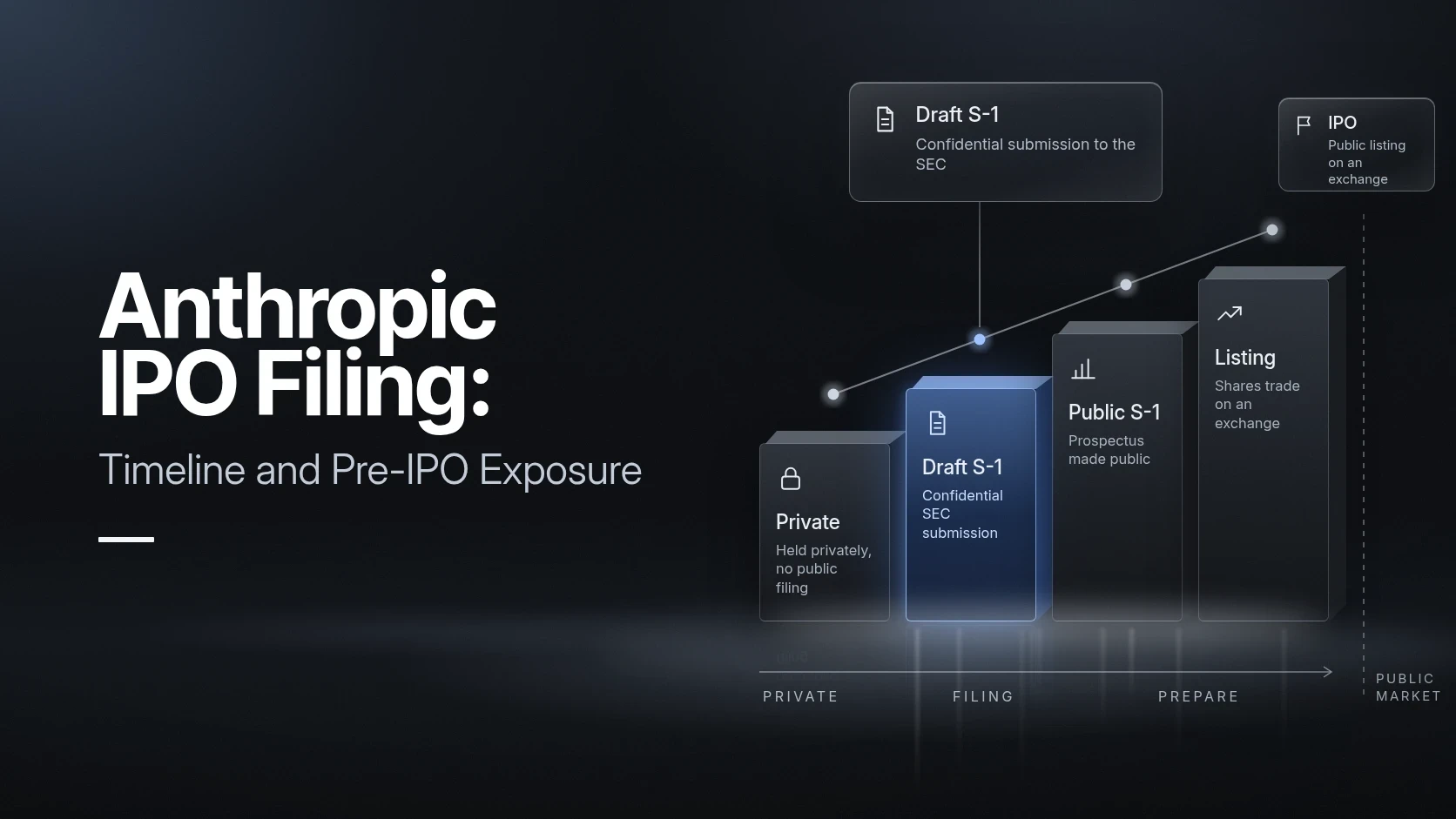
Anthropic IPO: Filing, Timeline & Pre-IPO Exposure
Anthropic filed a confidential draft S-1 on 1 June 2026. Here's what the reported prospectus shows, the likely timing and how Class F control works.

Anthropic Token: Price, Implied Valuation, and How to Get It
Anthropic token oANTHROPIC on OpenStocks: $1,050.20 USDT from PancakeSwap Infinity, +23.5% 30D, −0.5% vs mark. How to get the token on BNB Chain today.
