
Neuralink Net Worth & Valuation: Every Round to 2026
Neuralink's valuation, round by round: the $9.65B Series E, 2026 secondary prints of $29–42B, the key investors and what each number really measures.
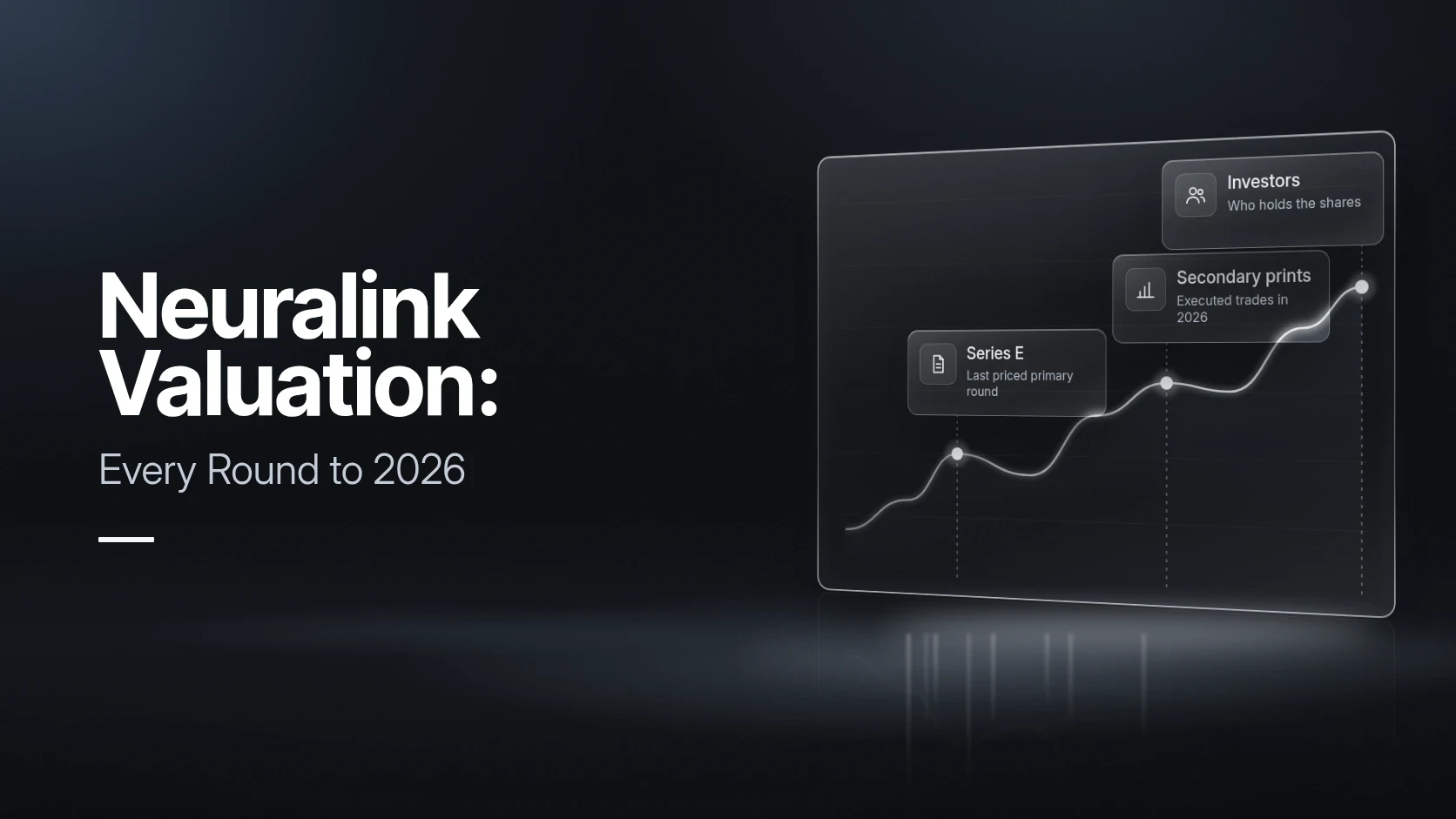
Neuralink's last priced valuation is $9.65 billion post-money, set by its Series E in June 2025 at $50.50 per share. Secondary-market trades in 2026 have implied far more, between roughly $29 billion and $42 billion, with some bids near $60 billion. When people search for "Neuralink net worth", these are the two numbers they are really asking about, and they measure very different things.
This page lays out every disclosed round, who invested, what the 2026 prints mean, and how to reconcile figures that differ by a factor of four.
As of October 2026: figures are from Forge data (updated August 2026), CB Insights, Caplight data reported by Business Insider (July 2026) and Nasdaq Private Market's public page (September 2026). Private valuations move fast; verify before relying on them.
Neuralink net worth vs valuation: what the term means
A company doesn't have a "net worth" the way a person does. Searchers usually mean one of three things:
Post-money valuation from a priced round. The price the company and a lead investor agreed, multiplied by the fully diluted share count. For Neuralink that is $9.65 billion (June 2025).
Implied valuation from secondary trades. What a buyer paid an existing holder for a small block, scaled up to the whole company. In 2026 that ranged from about $29 billion to $42 billion.
Book value. Assets minus liabilities. Neuralink doesn't publish financial statements, so nobody outside the company knows this number.
The first two are both real data points. They are just answers to different questions, a distinction covered in more depth in pre-IPO valuation explained.
Neuralink funding rounds and valuation history
Date | Round | Amount | Price / valuation | Notes |
|---|---|---|---|---|
2016 to 2021 | Seed to Series C | Undisclosed to ~$205M (Series C, 2021) | Not consistently disclosed | Founders Fund, Vy Capital among early backers |
2023 | Series D (incl. extension) | ~$323M total | $19.03/share, ~$3.5B post-money | Founders Fund led the August 2023 tranche |
2 June 2025 | Series E | ~$650M | $50.50/share, $9.65B post-money | Last confirmed priced round |
6 May 2026 | Series E-II | Undisclosed | Undisclosed | Oman Investment Authority, per CB Insights |
H1 2026 | Secondary trades | n/a | Implied $29B to $42B | Caplight data via Business Insider, July 2026 |
Forge's data puts total disclosed primary funding at about $1.34 billion through the Series E. The 2021 Series C figure is from contemporary reporting; earlier rounds were small and not all were announced.
From $3.5 billion to $9.65 billion
The Series E price of $50.50 was about 2.65 times the Series D price of $19.03. That step-up came with clinical progress: human implants and trial expansion turned Neuralink from a lab project into a company with patients. For a pre-revenue medical device company, that is how valuation moves: on regulatory and clinical evidence rather than earnings.
Who are Neuralink's investors?
Elon Musk co-founded Neuralink in 2016 and is widely reported to be the largest shareholder, though the exact stake has not been disclosed. Outside investors named in Series E data from Forge and CB Insights include:
Venture and growth funds: Founders Fund, Sequoia Capital, Thrive Capital, Lightspeed Venture Partners, ARK Invest, Vy Capital, Valor Equity Partners, DFJ Growth, Human Capital and K5 Global.
Sovereign and strategic capital: Qatar Investment Authority and Abu Dhabi's G42 in the Series E, and Oman Investment Authority in the 2026 Series E-II.
Smaller syndicates and SPV managers: several appear in Series D data, which is one reason Neuralink exposure circulates through so many fund vehicles.
Gulf sovereign participation is notable in its own right: three state-backed investors from the region now sit on Neuralink's register, which partly explains the strong search interest from the Gulf.
Why secondary prints are 3x to 4x the last round
Business Insider reported in July 2026, citing Caplight, that Neuralink shares had changed hands at implied valuations from $29 billion to $42 billion, with some bidders trying to buy near $60 billion. Nasdaq Private Market's public page showed an indicative price of $253.00 per share as of 15 September 2026. On the Series E share count, that is about five times the $50.50 round price.
Four structural reasons explain the gap:
Scarcity. Very few shares are available, and transfers need company consent. Small supply against broad demand pushes prints up.
Theme demand. There is no listed pure-play brain-computer interface company of comparable profile, so Neuralink is the default way to express the theme.
Musk-group sentiment. After SpaceX's June 2026 IPO, secondary prices across Musk-linked companies moved higher, according to the same reporting.
Share class and structure. Secondary prints often involve common stock or SPV units with fees and carry, so headline prices are not always comparable with preferred-share round prices.
None of this makes the prints wrong. It means they tell you what marginal buyers will pay today, while the round tells you what the company agreed with diligence-heavy investors a year earlier. How pre-IPO stock prices are set walks through the mechanics.
How to read Neuralink's valuation on OpenStocks
Neuralink is live on OpenStocks as oNEURALINK, a BEP-20 token on BNB Chain that provides economic price exposure only. It gives no shares, voting, dividends or information rights. OpenStocks is not affiliated with Neuralink, and the product is not available to US persons or anyone in the United States.
The product page shows two valuations side by side:
Field | What it measures | How to use it |
|---|---|---|
Implied valuation | Token price scaled to the whole company | What the onchain market is paying now |
Mark valuation | Reference price from the product's mark source | The anchor the token is compared against |
Premium % | Gap between the two | Whether the token trades rich or cheap to its reference |
That layout makes it easy to compare onchain pricing with the round and secondary numbers above. For the full method, read implied valuation vs mark valuation and the token page oNEURALINK: price and implied valuation. If you are weighing whether to take exposure at all, how to invest in Neuralink pre-IPO covers access routes and eligibility.
What would change Neuralink's valuation next
A new priced primary round. This is the cleanest reset. A round near secondary levels would validate them; a round well below would deflate them.
Regulatory milestones. Progress towards commercial approval for a first indication would change the revenue outlook.
An IPO filing. A public S-1 would reveal the share count, cash and burn for the first time. We track that path in Neuralink IPO date: will Neuralink go public?
Adverse events. Safety findings in trials would hit sentiment fast, especially at today's multiples.
What "Neuralink net worth" searches usually get wrong
Three mistakes show up again and again in pages that rank for this term.
Treating a secondary print as the valuation. A trade on a private marketplace is one buyer and one seller agreeing a price for a small block, often of common stock. The company's priced round sets the price of new preferred shares with their own rights. Both are real data points, but they measure different things.
Confusing the company with its founder. Neuralink's valuation is not Elon Musk's net worth, and Musk's stake in Neuralink is not public. Estimates of his holding in rich lists are just that: estimates.
Ignoring dilution. Each new round issues new shares. A higher headline valuation can coexist with a smaller percentage for early holders, which matters if you are trying to work out what any individual stake is worth.
The cleaner way to think about it: the last priced round is the floor that institutions actually paid, and secondary prints are a noisy signal of where demand sits today. For how founders, investors and voting control can split in a high-profile private company, our Anthropic cap table breakdown is a useful comparison.
Key takeaways
Neuralink's last priced valuation is $9.65 billion (Series E, June 2025, $50.50 per share).
2026 secondary trades implied $29 billion to $42 billion; one indicative price was $253 per share in September 2026.
A May 2026 Series E-II with Oman Investment Authority was undisclosed in size and price.
"Net worth" searches usually mean valuation. Book value isn't public.
Use round prices as anchors and secondary or onchain prices as sentiment gauges, and keep the two apart.
FAQ
What is Neuralink's net worth in 2026?
Neuralink doesn't publish a balance sheet. Its last priced valuation was $9.65 billion in June 2025, while 2026 secondary trades implied $29 billion to $42 billion.
How much has Neuralink raised?
About $1.34 billion in disclosed primary funding through the June 2025 Series E, per Forge. The size of the May 2026 Series E-II was not disclosed.
Who owns Neuralink?
Elon Musk is reported to be the largest shareholder. Other holders include Founders Fund, Sequoia, Thrive, ARK, Vy Capital, Gulf sovereign funds and employees.
Is Neuralink worth $42 billion?
Some secondary buyers paid prices implying that in 2026. That is a market print for small blocks, not a company-agreed valuation.
What company owns Neuralink?
No company owns Neuralink. Neuralink Corp. is an independent private company co-founded by Elon Musk and a group of scientists in 2016. It is not a subsidiary of Tesla, SpaceX or any other listed company, so buying those stocks does not give you Neuralink exposure.
Disclaimer
OpenStocks tokens represent economic price exposure only. They do not confer ownership, voting rights, dividends or information rights. OpenStocks is not affiliated with Neuralink or any company or investor mentioned. Not available to US persons or persons in the United States. Eligibility depends on your jurisdiction; see the Terms for the full list of prohibited jurisdictions. This is not investment advice. Pre-IPO exposure is high risk, including possible total loss, and liquidity is not guaranteed.
Related Articles

Anduril Token: Price, Implied Valuation, and How to Get It
Anduril token oANDURIL on OpenStocks: live token vs mark price, implied valuation, liquidity, BEP-20 contract address, and how to Get or Trade on BSC.
Anthropic IPO: Filing, Timeline & Pre-IPO Exposure
Anthropic filed a confidential draft S-1 on 1 June 2026. Here's what the reported prospectus shows, the likely timing and how Class F control works.

Anthropic Token: Price, Implied Valuation, and How to Get It
Anthropic token oANTHROPIC on OpenStocks: $1,050.20 USDT from PancakeSwap Infinity, +23.5% 30D, −0.5% vs mark. How to get the token on BNB Chain today.
