
Pre-IPO Investing Guide 2026 | OpenStocks
Pre-IPO investing guide for 2026: access paths, accreditation, secondaries, valuations, and how tokenized economic exposure differs from buying private shares.

Pre-IPO investing starts with structure
Pre-IPO investing seeks economic participation in private companies before they list. The hard part is matching structure to eligibility, risk tolerance, and liquidity needs-not memorizing logos.
In 2026, more headlines talk about private giants than ever, which expands curiosity and confusion. Treat each opportunity as a legal instrument first and a story second.
Four rails investors actually use
Primary venture and growth rounds are relationship-driven and document-heavy. Secondary share purchases depend on company consent and can take weeks. Funds and SPVs lower tickets but change what you own. Tokenized economic exposure can settle on-chain for eligible users without granting equity.
Confusing these rails is the most expensive beginner error in pre-IPO investing. Two opportunities with the same company name can produce opposite rights outcomes.
Skills that compound
Build valuation literacy across funding marks, secondary prints, and live quotes. Build document literacy for preferences and transfer limits. Plan liquidity before entry. Check jurisdiction every time. Maintain custody and wallet hygiene.
Process beats prediction. A written journal of marks, premiums, and decision dates will outperform informal memory when markets gap.
Risk budgeting
Illiquidity is often the main risk after business failure. A position you cannot exit on your schedule behaves differently from a public ETF sleeve. Tokenized books can improve optionality for eligible users, but depth can still vanish.
Never size private exposure as if daily volume were guaranteed. Cap loss at levels that do not force fire sales into empty books.
Core pre-IPO investing principles
Eligibility before enthusiasm.
Instrument clarity before price shopping.
Exit planning before entry.
Diversification across illiquid names and structures.
Ongoing monitoring after each financing.
Question | Why it matters |
|---|---|
Shares or exposure? | Rights differ completely |
Who sets price? | Round vs marketplace vs AMM |
How do I exit? | Tender, broker, or on-chain |
IPO handling? | Contracts control outcomes |
Counterparty? | Company, fund, broker, or market |
A durable investing workflow
Define eligibility first.
Build an underwritable watchlist.
Demand transparent pricing methodology.
Cap size for illiquidity and total loss.
Revisit thesis after financings.
Journal marks, premiums, and decisions.
Important disclosures
OpenStocks tokens provide economic exposure only. They are not equity and confer no voting, dividends, or information rights. Not affiliated with Anthropic, Figure AI, Anduril, Neuralink, or other named issuers. Not available to US persons or persons in the United States. Not investment advice. High risk including total loss. Liquidity is not guaranteed.
Related Articles

Anduril Token: Price, Implied Valuation, and How to Get It
Anduril token oANDURIL on OpenStocks: live token vs mark price, implied valuation, liquidity, BEP-20 contract address, and how to Get or Trade on BSC.
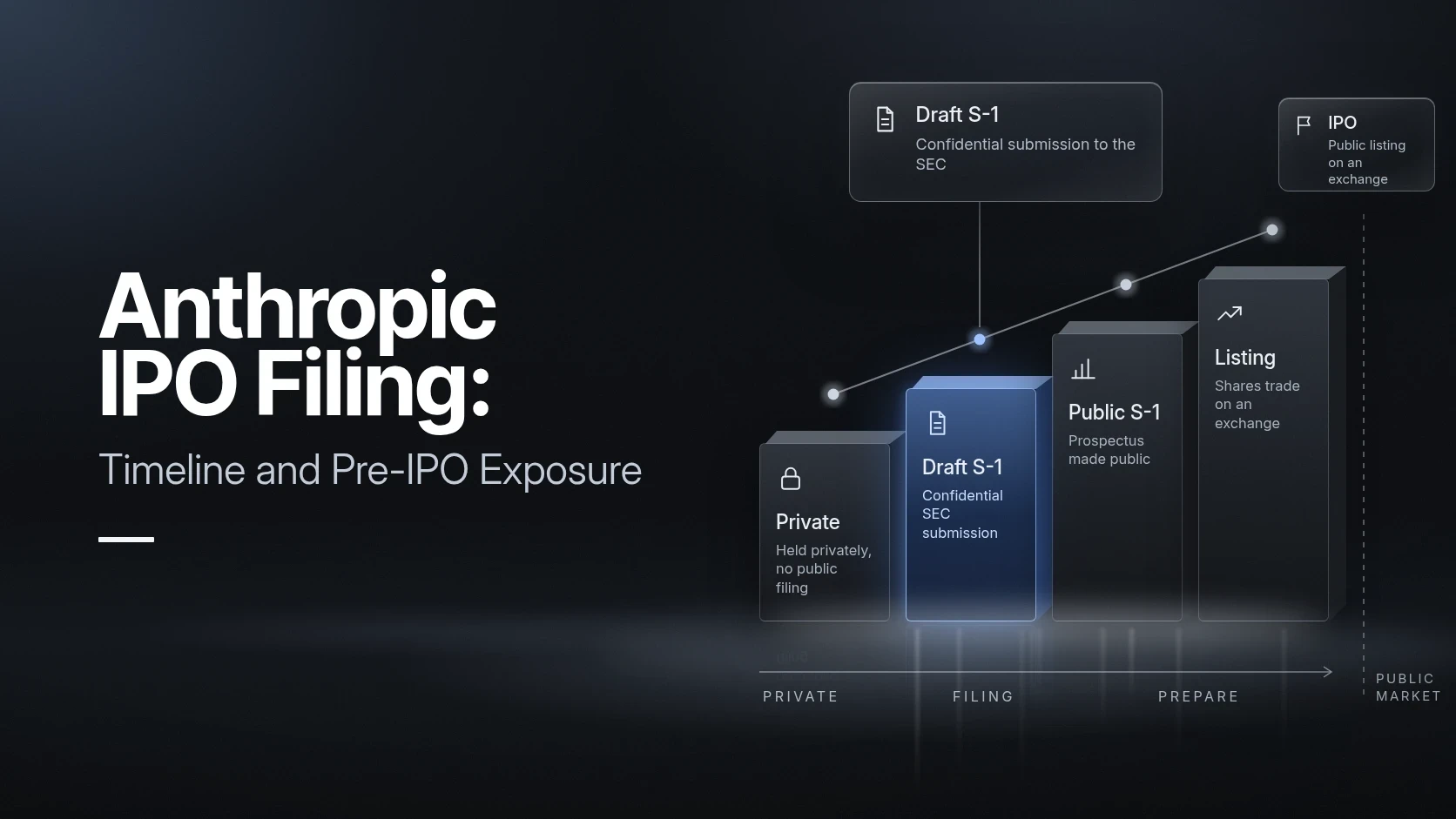
Anthropic IPO: Filing, Timeline & Pre-IPO Exposure
Anthropic filed a confidential draft S-1 on 1 June 2026. Here's what the reported prospectus shows, the likely timing and how Class F control works.

Anthropic Token: Price, Implied Valuation, and How to Get It
Anthropic token oANTHROPIC on OpenStocks: $1,050.20 USDT from PancakeSwap Infinity, +23.5% 30D, −0.5% vs mark. How to get the token on BNB Chain today.
