
What Are Tokenized Pre-IPO Stocks? A Complete 2026 Guide
Learn what tokenized pre-IPO stocks are, how they provide economic exposure to private companies, and what to check before investing in 2026.

What Are Tokenized Pre-IPO Stocks? A Complete 2026 Guide
For most of modern financial history, the best years of a company's growth happened where ordinary investors could not reach. Tokenized pre-IPO stocks are an attempt to change the access problem — not by changing securities law, but by changing what is being traded.
This guide explains what these instruments are, how they are constructed, how to verify one, and what to look for in a well-built product.
The problem they exist to solve
Companies stay private far longer than they used to. The median age at IPO across roughly 9,300 U.S. listings since 1980 is about nine years — but it reached 14 years in 2024 and 12 years in 2025. There are now around 1,700 private companies valued above $1 billion, worth roughly $8.6 trillion combined, against 228 worth about $800 billion a decade earlier.
That value accrues to a narrow group. Buying into it directly requires accredited-investor status — roughly $200,000 income or $1 million net worth excluding your home — and, in practice, minimums around $100,000 for a direct secondary ticket, company consent for the transfer, and weeks of settlement. Pooled vehicles lower the minimum but hand you a fund interest rather than stock.
The result is a market that is enormous, widely discussed, and closed.
What a tokenized pre-IPO stock actually is
A tokenized pre-IPO stock is a blockchain token that provides economic exposure to the value of a private company's equity. The critical word is exposure.
It is not a share. It typically confers no ownership rights, no voting rights, no dividends, no information rights and no other legal entitlements. You are taking a position on a valuation, not joining a cap table.
Under that umbrella, constructions differ — and the difference is worth knowing, because it determines what actually sits behind your position.
Unauthorized claims: a vehicle sells an interest in shares whose transfer the underlying company never approved. In June 2026, both OpenAI and Anthropic voided transfers of this kind.
Bare synthetics: no underlying position and no collateral — the token simply tracks a reference price, so everything rests on its oracle.
Overcollateralized protocol exposure: the model OpenStocks uses, and the reason it holds up better than either of the above: OpenStocks states that positions are overcollateralized with pre-IPO equity, with risk managed through documented on-chain logic — health factors, margin-call warnings, loan maturities and defined handling for corporate events such as stock splits. Collateral sits in front of the exposure rather than behind a promise, and every contract is source-verified on-chain. The full framework is set out in how lending against pre-IPO exposure works.
That last distinction is the whole subject. Two tokens can track the same company and be entirely different instruments — one collateralized and verifiable, another a claim the issuing company can void. The token symbol tells you nothing about which you hold.
Where this sits in the wider RWA market
Tokenized equity is a small corner of a large and fast-growing sector. Total tokenized real-world asset value, excluding stablecoins, sat somewhere between roughly $33 billion and $60 billion in mid-2026 depending on methodology — up several-fold from a year earlier. Tokenized Treasuries are the largest single category at around $16 billion. Tokenized equities are roughly $0.5–1 billion, up from around $424 million in mid-2025.
Within that, one research estimate put pre-IPO-specific token trading volume at about $544 million in the first half of 2026, with roughly 265,000 holders by mid-June. Definitions vary widely between trackers — that figure counts venue trading volume on a defined set of pre-IPO products, and it should not be read as the total capital that has passed through the category.
One structural fact worth carrying with you: access is geographically defined. Around 97% of tokenized assets are unavailable to U.S. retail investors, and nearly every pre-IPO platform, OpenStocks included, is unavailable to U.S. persons under Regulation S.
The infrastructure has nonetheless legitimized quickly. The SEC confirmed in January 2026 that tokenized securities remain securities. Nasdaq received approval for tokenized securities trading in March 2026. FINRA approved the first broker-dealer custody arrangement with atomic settlement in May. Securitize listed on the NYSE in July.
What good looks like: a verification checklist
What separates a well-built instrument from a weak one is knowable before you buy. Work through this:
1. Is the contract verifiable on-chain? You should be able to open the token contract on a block explorer and see verified source code. OpenStocks publishes contract addresses on BscScan for each product — for example the Anthropic, Figure AI, Anduril and Neuralink tokens on BNB Chain — and states that all contracts are source-verified.
2. Have the contracts been audited, and are findings resolved? OpenStocks' Security Center lists audit reports dated September 2025 (an independent QuillAudits smart-contract audit) and June 2026 (a trade-module security audit and re-audit), with three high findings recorded as resolved. An audit with unresolved high findings is a red flag; no audit at all is a bigger one.
3. What is the backing, stated plainly? "Overcollateralized with pre-IPO equity" is a claim you can hold an issuer to. Vague language is not.
4. Can you see the premium? A serious venue publishes both a token price and a reference mark price, and the gap between them. OpenStocks shows token price, mark price, implied valuation, mark valuation and premium percentage on every product page. If a platform shows you only one price, you cannot tell whether you are paying a premium.
5. Is liquidity published? Pool liquidity, 24-hour volume and trade count should be on the page, not in a support article — and verifiable on-chain. OpenStocks publishes all three on every product page.
6. What happens at an IPO or a corporate event? This should be documented in advance. OpenStocks sets out its handling of corporate events, including atomic stock-split adjustment, in its app FAQ.
Why structure is the thing to check
June 2026 gave the market a useful lesson in why the checklist above matters. When SpaceX listed, several tokenized products elsewhere could not secure their underlying allocations, and both OpenAI and Anthropic voided SPV transfers they had never authorized.
The takeaway is not that tokenization does not work — it is that the structure is the investment. Two tokens can track the same company and have entirely different claims behind them, which is exactly why a verifiable contract, published audits and an overcollateralized model are worth insisting on. We look at that period in what the SpaceX IPO taught private-market investors, and set out the access barriers and what replaces them in how to buy pre-IPO shares.
What tokenization adds
Three things stand out:
Fractional access: a $100,000 minimum becomes a position you can size yourself.
No dependence on an exit event: because the token is an ordinary on-chain asset, exposure can be adjusted without waiting for a tender offer that historically came around every four months at best.
Composability: because exposure is on-chain, it can be used rather than just held — as collateral, or inside other protocols. OpenStocks documents a lending framework built on exactly this: see how lending against pre-IPO exposure works.
For company-specific worked examples, see our guides to Anthropic, Figure AI, Anduril and Neuralink.
FAQ
Do tokenized pre-IPO stocks give me equity in the company?
They provide economic exposure to a company's valuation rather than registered shares.
Are they legal?
Regulatory treatment varies by jurisdiction. Nearly every platform, including OpenStocks, excludes U.S. persons.
What happens when the company IPOs?
It depends on the instrument's structure, so check the product documentation for the behavior at a listing.
How do I verify a token is real?
Check five things: the on-chain contract, the audits, the published backing, the premium and the published liquidity. OpenStocks publishes all five.
Related Articles

Anduril Token: Price, Implied Valuation, and How to Get It
Anduril token oANDURIL on OpenStocks: live token vs mark price, implied valuation, liquidity, BEP-20 contract address, and how to Get or Trade on BSC.
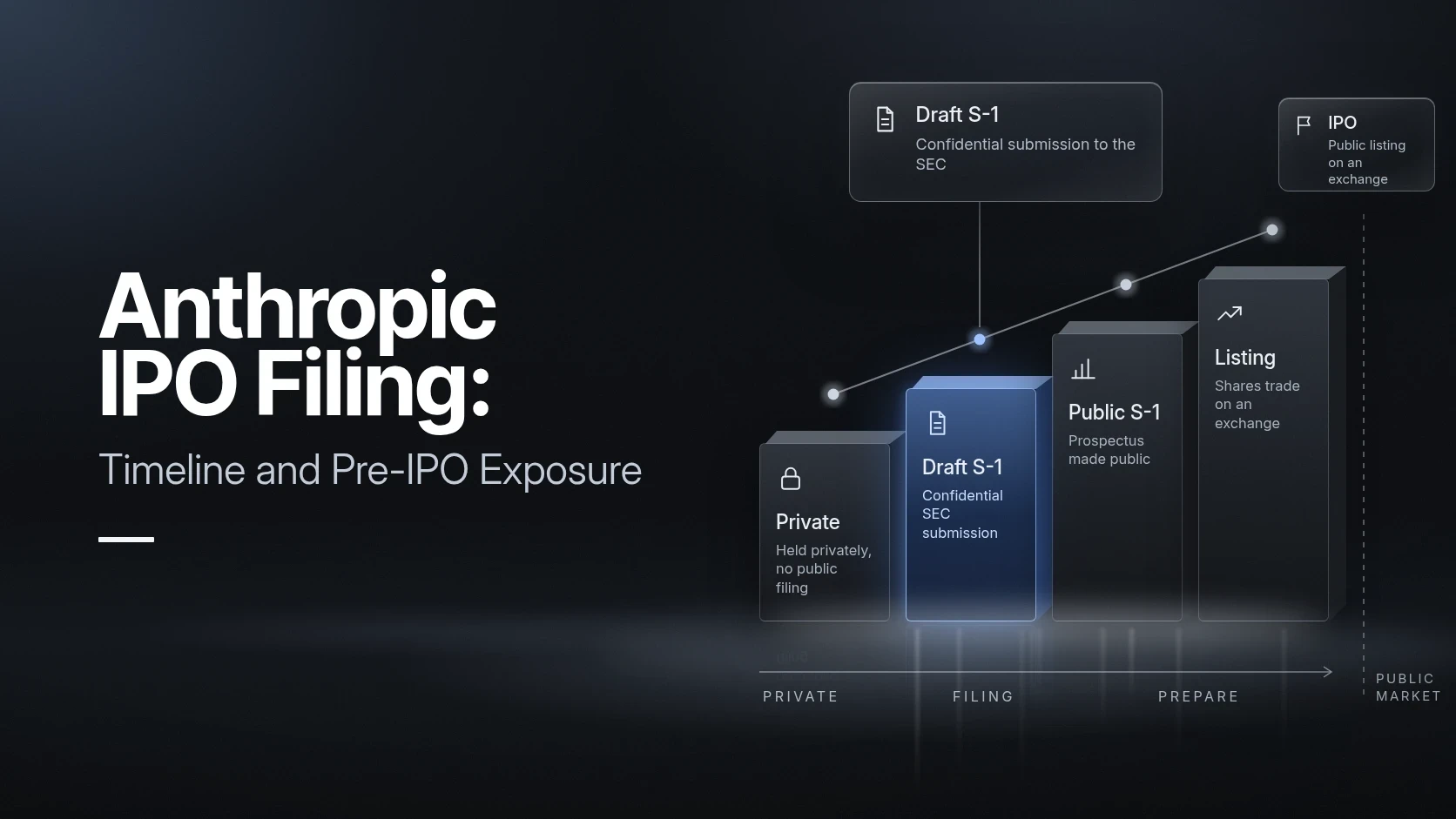
Anthropic IPO: Filing, Timeline & Pre-IPO Exposure
Anthropic filed a confidential draft S-1 on 1 June 2026. Here's what the reported prospectus shows, the likely timing and how Class F control works.

Anthropic Token: Price, Implied Valuation, and How to Get It
Anthropic token oANTHROPIC on OpenStocks: $1,050.20 USDT from PancakeSwap Infinity, +23.5% 30D, −0.5% vs mark. How to get the token on BNB Chain today.
